Assemble
Generate audit-proof, Bates-stamped exhibit packets in one click.
The index, the page numbers and the citations are generated from one model, so they cannot disagree with each other. That is the whole difference between assembly and PDF manipulation.
- Largest tested binder
- 1,400 pp
- Index tiers
- 2
- Export modes
- 3
- E-filing size cap
- <12 MB
Ramírez — EB-2 NIW exhibit binder
340 pp · DOE-NIW-0001 → DOE-NIW-0340 · rev 4
Tier one — exhibit index
Dhanasar Prong 2
Exhibit 3 — Prong 2 — Well positioned to advance
26 I&N Dec. 884, 890 · DOE-NIW-0122 → 0268
- 3.1 Decl. of Dr. E. Moreau (ETH Zürich)pp. 122–137
- 3.2 Decl. of Dr. A. Whitfield (NREL)pp. 138–152
- 3.3 Decl. of Prof. R. Sato (Tohoku Univ.)pp. 153–166
- 3.4 Adoption evidence — 3 national labspp. 167–214
- 3.5 Peer review record, 4 journalspp. 215–268
Exhibit 3.3 — Japanese-language annex at pp. 161–166 has no translator competence certificate (8 CFR 103.2(b)(3)). Held from the compiled binder.
What it generates
Six artefacts from one assembled binder.
- Two-tier exhibit index
- Tier one groups by statutory criterion with its regulatory citation. Tier two identifies each document with a full page range and a one-line statement of what it establishes. Not a table of contents — a finding aid.
- Sequential Bates numbering
- Continuous across the entire binder from the first page of the cover letter to the last page of the last exhibit, with a customisable prefix and suffix. Four digits minimum, because merit binders routinely pass three hundred pages.
- Tab divider sheets
- Pre-formatted separator pages carrying the exhibit number and short description, sized and positioned for physical filing. Generated against the index, so they can never describe an exhibit that moved.
- Dynamic table of contents
- Live PDF bookmarks mirroring the two-tier structure, plus internal hyperlinks so a reader on screen jumps from an index row straight to the first page of the exhibit.
- Exhibit cover sheets
- A cover page per tier-one group carrying the criterion, its citation and the Bates range the group spans — the page an adjudicator lands on when they follow the index.
- Assembly audit record
- A signed record of what was assembled, what was redacted, what was held out and who approved it. Corporate immigration programs use this as filing-quality evidence for their clients.
Anatomy
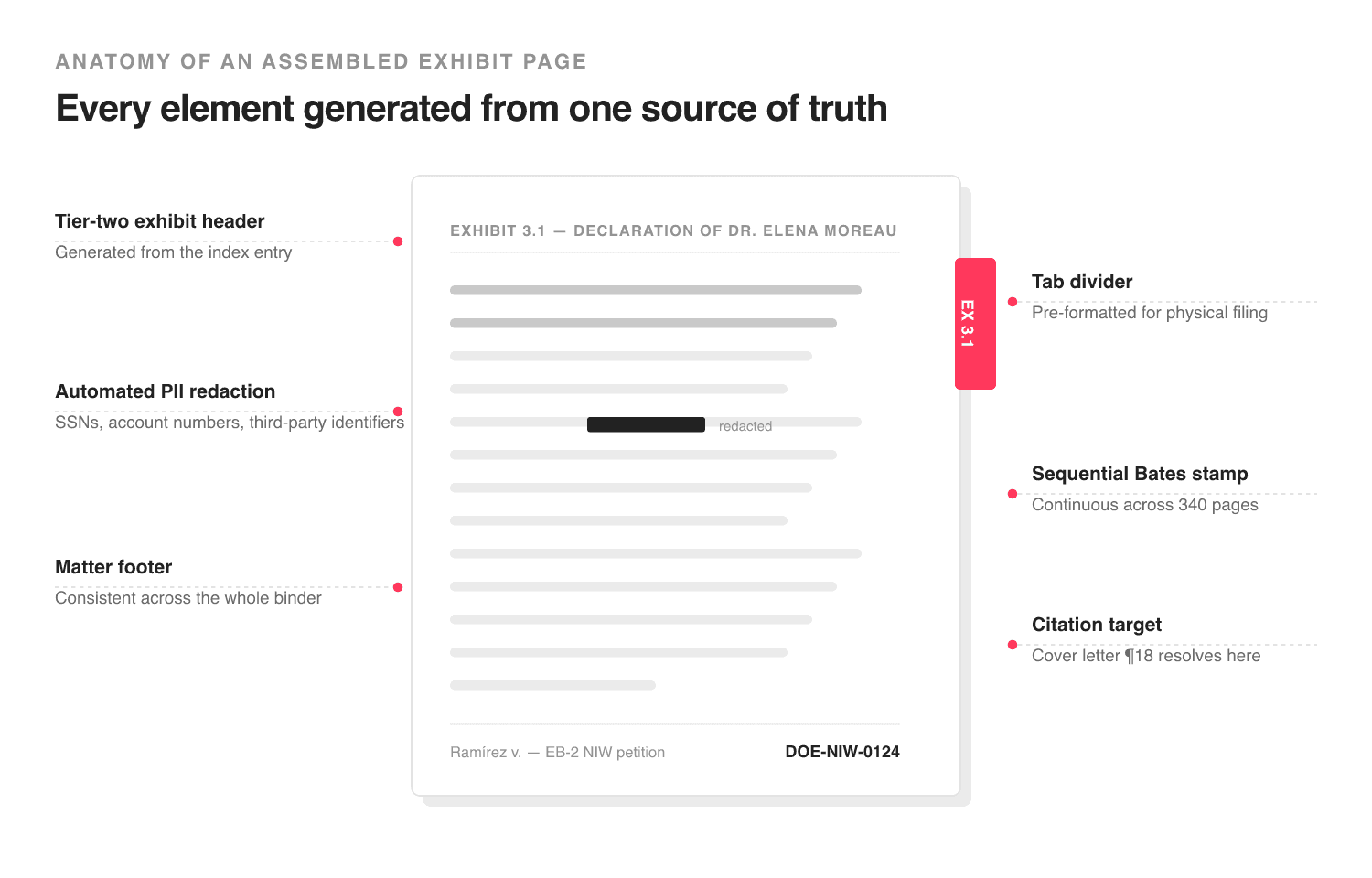
Every element on the page has one source.
The header comes from the index entry. The footer comes from the matter. The Bates stamp comes from the binder position. The redaction comes from the intake scan. Change any upstream fact and the page regenerates — there is nothing to keep in sync by hand.
Export
How a packet is filed changes what it has to be.
Three export paths from the same assembled binder, chosen at export time rather than at assembly time.
USCIS online account
Split and compressed under the 12 MB per-file limit with bookmark structure preserved, plus a filing manifest listing every part and its Bates range.
Up to 9 parts · manifest included
Print-ready split set
Separate exhibit files with tab divider sheets and a printable index, paginated for physical mail filing and duplex printing.
Tab sheets · duplex-safe pagination
Single merged PDF
One compiled file with live bookmarks and internal hyperlinks, for the firm's own records, client delivery and case management write-back.
Bookmarks · internal links · searchable
Any scheme you define. Most firms use beneficiary surname plus form type plus sequence — DOE-NIW-0001 — because it stays stable through a refiling. Firm-code and matter-number schemes work equally well. Date-based prefixes are supported but we advise against them; they break when a matter is refiled.
Start free trial
Stop losing flat-fee profit to manual PDF formatting.
Upload one messy client folder. Get back an audit-ready, Bates-stamped exhibit packet with a two-tier index and a matched cover letter — in about three minutes.
14-day free production trial · no card · real matters · no watermark
Software for licensed attorneys. Not legal advice.